
Freddie Mac's Cost to Originate Study (2024 and 2025 Update), Explained
Freddie Mac's 2024 Cost to Originate Study found retail lenders spent about $11,600 per loan in Q3 2023, and its November 2025 update put Q2 2025 at about $11,800. Here is what both found, where they are strong, and what they leave out, as part of our cost to originate guide.
What Is the Freddie Mac Cost to Originate Study?
It's research from Freddie Mac's Market Insights group, published in May 2024. It draws on financial data from 203 mortgage lenders (primarily non-banks, benchmarked against MBA's performance report), a survey of 500 loan professionals, interviews with 13 executives, and Freddie Mac's own tool-usage data.
One point matters for everything below: Freddie Mac sells the digital tools the study measures, so it has an interest in the technology conclusions. The study is available from Freddie Mac.
What Did It Find About the Cost?
For retail-only lenders, the cost to originate averaged about $11,600 per loan in Q3 2023. That was roughly $2,400, or 26%, more than the last downturn in Q4 2018, and about $3,000, or nearly 35%, more than Freddie Mac's first study in Q4 2020, a time of low rates and high volume.
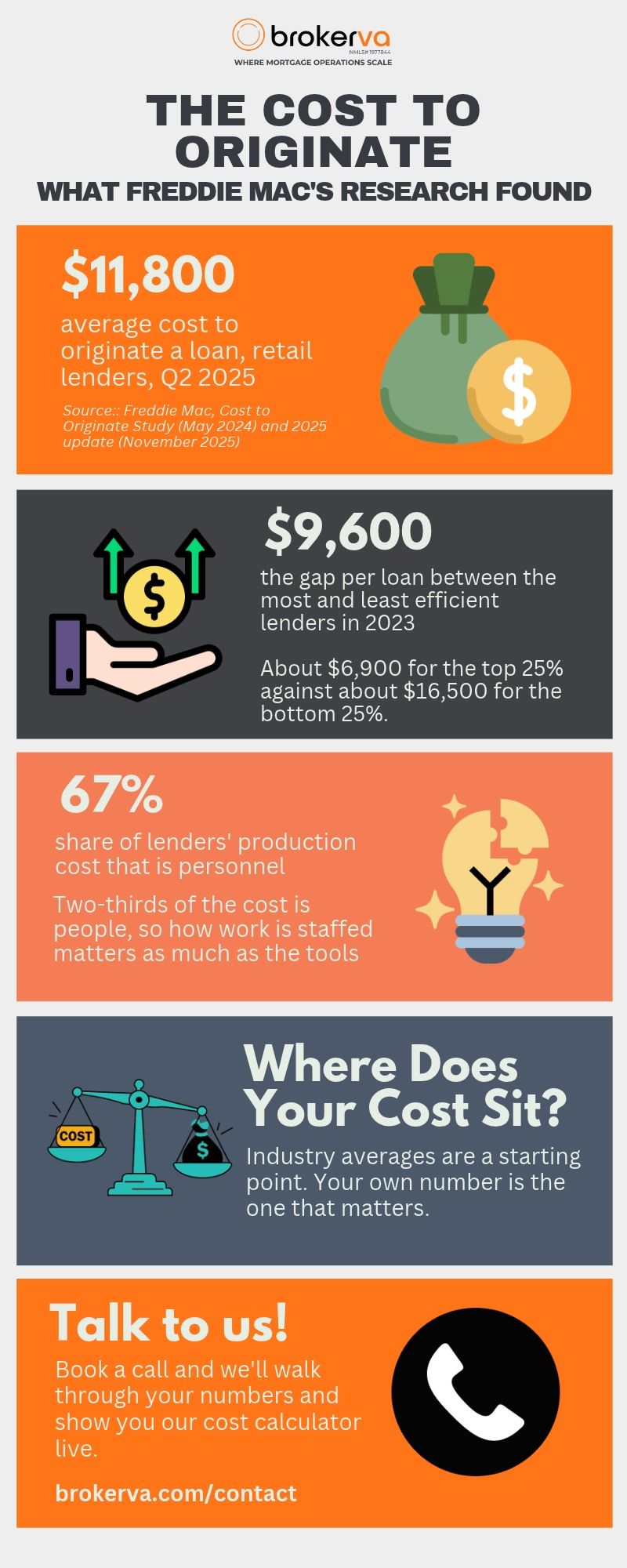
Freddie Mac's November 2025 update put the average at about $11,800 in Q2 2025. That was down from $13,400 in Q1 2025 but still about $200 above Q3 2023. Retail lenders also reported pre-tax net income of $900 per loan, the highest since 2021.
For a figure from a different source, MBA reported that production costs were $11,898 per loan in Q1 2026. The two series use different samples and definitions, so don't treat them as one trend line.
Why Did Costs Rise?
The study names four contributors and doesn't quantify how much each one added:
- Inflation, especially in vendor technology fees, credit reports, and third-party verifications
- Production mix, since purchase loans tend to be more complex, labor-intensive, and time-consuming
- Economies of scale, since lower volume spreads costs across fewer loans
- A growing technology stack, with technology-related expenses per loan rising from 2% to 4% over three years
We cover two of these in depth: Does Scale Lower Your Cost to Originate? and Purchase vs. Refinance.
How Big Is the Gap Between Lenders?
Wider than most people expect. The top 25% of lenders averaged about $6,900 per loan, and the bottom 25% about $16,500, which is a difference of $9,600 and roughly 2.4 times. The study says the best performers originate at nearly half the industry average, and that some institutions manage production costs better than others whatever the market looks like.
That gap is the most useful finding in the report: cost isn't only a function of the market. How a lender operates matters a great deal.
What Did It Find About Technology?
Four separate things, which are easy to blur together.
What lenders believe. Most surveyed respondents think a fully digital process could cut cost per loan by as much as 40%. That is a belief, not a measurement.
What the 2024 data shows. Lenders that used Freddie Mac's tools for at least 75% of the volume they sold to Freddie Mac averaged about $10,800 per loan against about $12,300 for those using them on under 60%, a difference of about $1,500, or 14%. Net margin was 3.7% against negative 6.3%. The study calls this a correlation.
What Freddie Mac estimates. The study puts personnel savings at $165 to $388 per loan, or 2% to 5% of labor cost, and total savings at roughly $230 to $570. These rest on Freddie Mac's own assumptions.
What the 2025 update adds. The November 2025 update says heavy users now save about $1,700 per loan, with production about five days shorter, up to $610 per loan in personnel and funds-related savings, and a 1.8% higher pull-through rate. It's still a vendor's analysis of its own tools, comparing heavy and light users.
For a fuller look, see Does Digitization Really Cut Mortgage Origination Cost?.
What Does the Study Say About People?
This is the part most summaries skip. Personnel expenses represent about two-thirds (67%) of lenders' total production costs. The study lists the tactics lenders use to control costs: expanding technology (two of the top three), focusing on customer satisfaction, eliminating or combining functions, outsourcing and/or reducing staff, and negotiating vendor prices. It also says the leading organizations manage costs by scrutinizing contracts, eliminating duplicative work, and matching the right resources to the right loans.
Its own conclusion: "Technology is not a standalone solution but a strategic enabler." In other words, tools help most when processes and staffing change with them.
What Did the Study Leave Out?
This section is our analysis, not the study's.
- Retail only. The cost data covers retail and consumer-direct lenders. Wholesale and broker operations aren't broken out.
- Partly dated figures. The 2025 update refreshes the average cost and the tool-usage results to Q2 2025, but not the lender-size or top and bottom quartile figures, which remain 2023 numbers.
- Heavy users versus light users. The main efficiency result compares groups that may differ in other ways.
- Modeled savings. The per-loan and revenue estimates depend on Freddie Mac's assumptions.
- Little on staffing models. Personnel is two-thirds of cost, yet outsourcing appears only as a bullet in a list.
- A vendor's interest. The conclusions favor technology Freddie Mac sells.
None of that makes the work wrong. It makes it a strong reference for the size of the problem and a thinner guide to every solution.
What Should You Take From It?
Know your own number first (see How to Calculate Your Cost to Originate a Mortgage), look at people as well as tools, treat savings estimates as hypotheses to test on your own files, and review vendors and duplicated work, as the leaders do.
How Does BrokerVA Fit?
BrokerVA's goal is to lower your cost to originate, and the study's findings point to where. We have 150+ mortgage operations specialists organized into five stage-based roles, Setup, Disclosure, Closing, Funding, and Post-Closing, so repeatable file work can be handled by people dedicated to one stage, and we may be able to tailor roles to your business. That speaks to the study's point about matching resources to loans, and to its caution that technology isn't a standalone fix.
Every client gets a dedicated Coach for a 6-week implementation, then ongoing coaching and regular check-ins. We can't promise a specific saving, since it depends on your operation, but on a call we'll walk through your numbers and show you our cost calculator live. Pricing is customized to your volume and the roles you need. See how BrokerVA works.
Frequently Asked Questions
What did Freddie Mac's Cost to Originate Study find? That retail lenders averaged about $11,600 per loan in Q3 2023, up nearly 35% in three years, and that the top 25% of lenders averaged about $6,900 against about $16,500 for the bottom 25%.
Why did the cost to originate rise? The study names inflation, a purchase-heavy mix, lower volume, and a growing technology stack. It doesn't say how much each contributed.
Does digitization cut the cost to originate? Lenders believe it can by up to 40%. The measured link is about $1,500 per loan between heavy and light users of Freddie Mac's tools in the 2024 study, and about $1,700 in the 2025 update. It compares heavy and light users, and Freddie Mac sells those tools.
Sources
- Freddie Mac, 2024 Cost to Originate Study (May 2024)
- Freddie Mac, 2025 Updates to the Cost to Originate Study (November 18, 2025)
- Freddie Mac, 2024 Cost to Originate Study overview
- Mortgage Bankers Association, Q1 2026 IMB production profits release (May 15, 2026)
Want to see where your cost to originate sits? Book a call with BrokerVA and we'll walk through your numbers and show you our cost calculator.
BrokerVA | NMLS #1977844